
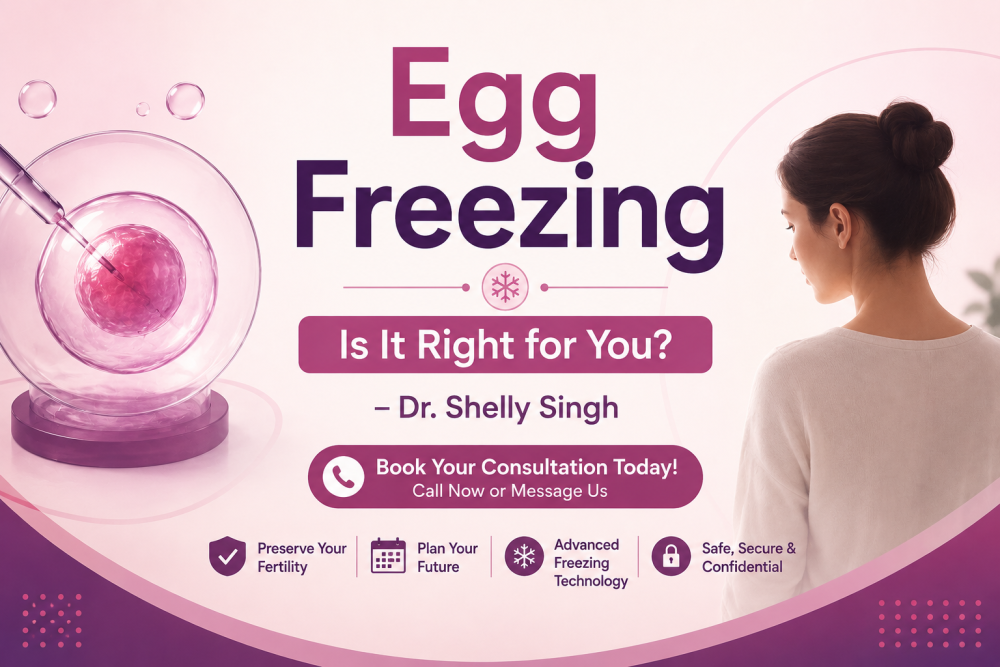
For many women, life does not always follow the timeline they imagined. Career goals, education, personal priorities, relationships, or simply not being ready for motherhood can influence when they want to have children. But fertility does have a biological timeline.
This is where egg freezing can become an option worth understanding.
As a gynaecologist, Dr. Shelly Singh often sees women who are not saying “I don’t want children.” They are saying, “I want children, but I’m not ready yet.” Egg freezing may offer these women an opportunity to preserve their younger eggs for possible use in the future.
But is it the right choice for everyone? Let’s understand.
What Is Egg Freezing?
Egg freezing, medically known as oocyte cryopreservation, is a fertility preservation technique in which a woman’s eggs are collected from the ovaries, frozen and stored for potential future use.
The process usually begins with hormonal medications that encourage the ovaries to develop multiple eggs. Once the eggs are mature, they are collected through a short procedure and frozen using a technique called vitrification.
Later, if pregnancy is desired, the frozen eggs can be thawed, fertilised with sperm and used during an IVF cycle.
Importantly, egg freezing does not guarantee a future pregnancy. Its success depends on several factors, particularly the woman’s age when the eggs are frozen and the number and quality of eggs collected.
Why Are Women Considering Egg Freezing?
Imagine a 32-year-old woman who is building her career. She wants to become a mother someday, but marriage or pregnancy may not be part of her immediate plans.
Another woman may need medical treatment that could affect her fertility. Someone else may simply want more time before starting a family.
simply want more time before starting a family.
These are some situations where fertility preservation for women may be discussed.
Egg freezing may be considered for:
- Women who wish to delay pregnancy for personal or professional reasons
- Women who are not currently ready to start a family
- Women undergoing certain medical treatments that may affect ovarian function
- Women who have concerns about declining fertility with age
- Women who want to explore fertility preservation after discussing their individual circumstances with a gynaecologist
Best Age for Egg Freezing: Why Timing Matters
One of the most important conversations Dr. Shelly Singh has with women considering fertility preservation is about age.
Women are born with a finite number of eggs, and both the quantity and quality of eggs generally decline with age. The decline becomes more noticeable as women move through their 30s.
This doesn’t mean pregnancy is impossible at an older age. Many women conceive naturally later in life. However, age is an important factor when discussing the potential success of fertility preservation.
That is why there is no single “perfect” age for every woman. A personalised fertility assessment can help determine whether egg freezing may be worthwhile in your situation.
What Does the Egg Freezing Procedure Involve?
The process generally includes several stages:
- Initial fertility assessment: Your medical history, ovarian reserve and reproductive goals are evaluated.
- Ovarian stimulation: Hormonal injections are used to encourage the development of multiple eggs.
- Monitoring: Ultrasound scans and blood tests help monitor follicle development.
- Egg retrieval: Mature eggs are collected through a minimally invasive procedure.
- Freezing and storage: Suitable eggs are frozen using vitrification and stored for future use.
The entire process requires planning and regular monitoring, so discussing expectations beforehand is important.
Egg Freezing Benefits and Limitations
One of the major egg freezing benefits is that it can provide women with an additional fertility-preservation option. It may reduce some of the pressure associated with delaying motherhood, particularly when fertility is a concern.
However, it is equally important to understand its limitations.
The number of eggs retrieved can vary from woman to woman. Not every frozen egg will necessarily survive thawing, fertilisation or embryo development. Therefore, egg freezing should be viewed as an opportunity to preserve fertility potential—not as a guarantee of having a baby later.
Is Egg Freezing Right for You?
There is no universal answer.
The right decision depends on your age, ovarian reserve, reproductive plans, medical history and personal circumstances. A consultation with an experienced gynaecologist can help you understand your fertility status and whether egg freezing in Delhi may be appropriate for you.
Dr. Shelly Singh believes that fertility decisions should be based on informed choices rather than fear or pressure. If you are thinking about delaying motherhood or simply want to understand your fertility options, an early conversation can help you plan with greater clarity.
Frequently Asked Questions About Egg Freezing
1. Is egg freezing painful?
Some women experience bloating, abdominal discomfort or mild side effects from the hormonal medicines. The egg retrieval procedure itself is generally performed under appropriate anaesthesia or sedation.
2. What is the best age for egg freezing?
There is no fixed age that applies to everyone. Generally, younger age is associated with better egg quality, which is why discussing fertility preservation earlier can be beneficial.
3. How long can frozen eggs be stored?
Frozen eggs can be stored for an extended period under appropriate laboratory conditions. The regulations and practical considerations around storage can vary, so your fertility specialist can explain the applicable rules.
4. Does egg freezing guarantee pregnancy later?
No. Egg freezing preserves eggs, but it cannot guarantee a future pregnancy. Outcomes depend on factors such as age at freezing, number of eggs retrieved, egg quality and future fertility treatment outcomes.
5. How many eggs should be frozen?
There is no universal number. The recommended number depends on factors including your age, ovarian reserve and individual fertility goals.
6. Is egg freezing suitable for every woman?
Not necessarily. A fertility evaluation is important before making a decision. Dr. Shelly Singh can assess your individual circumstances and discuss whether fertility preservation may be appropriate for you.
Conclusion
Choosing whether to freeze your eggs is a deeply personal decision. It is not about predicting the future—it is about understanding your present fertility and exploring the options available to you.
If you are considering egg freezing, speak with a qualified gynaecologist to understand your ovarian reserve, fertility potential, expected outcomes and available options.
Book a consultation with Dr. Shelly Singh to discuss egg freezing and personalised fertility preservation options in Delhi.