IUI vs IVF: When Is IUI Enough and When Should You Consider IVF?
Written by Dr. Shelly Singh, Obstetrician and Gynaecologist, New Delhi

Qualifications: MBBS, MD (Obstetrics & Gynaecology)

Registration:  DMC 16544

Couples who find it hard to conceive soon hear two terms again and again: IUI and IVF. IUI vs IVF is one of the most common questions in gynaecology clinics across India, and the answer is rarely the same for two couples.

This article explains IUI vs IVF in simple words, using the ICMR Standard Treatment Workflow for female infertility as the main reference. It is general information, not a substitute for a doctor’s opinion or a personal medical evaluation.

When Is a Couple Called Infertile?

What ICMR Says About Infertility

Before comparing IUI vs IVF, it helps to know when treatment is even needed. As per ICMR:

  • Infertility means no pregnancy after 12 months of regular unprotected sex in women below 35 years, or after 6 months in women above 35.
  • It affects up to 15% of couples.

Who Should Get Tested Early?

  • Women above 35 should be tested sooner, and women above 40 immediately.
  • Early tests are also advised with irregular periods, tubal or uterine problems, endometriosis, past pelvic surgery, or a known male factor.

What Is the Difference Between IUI and IVF?

What Is the Difference Between IUI and IVF?

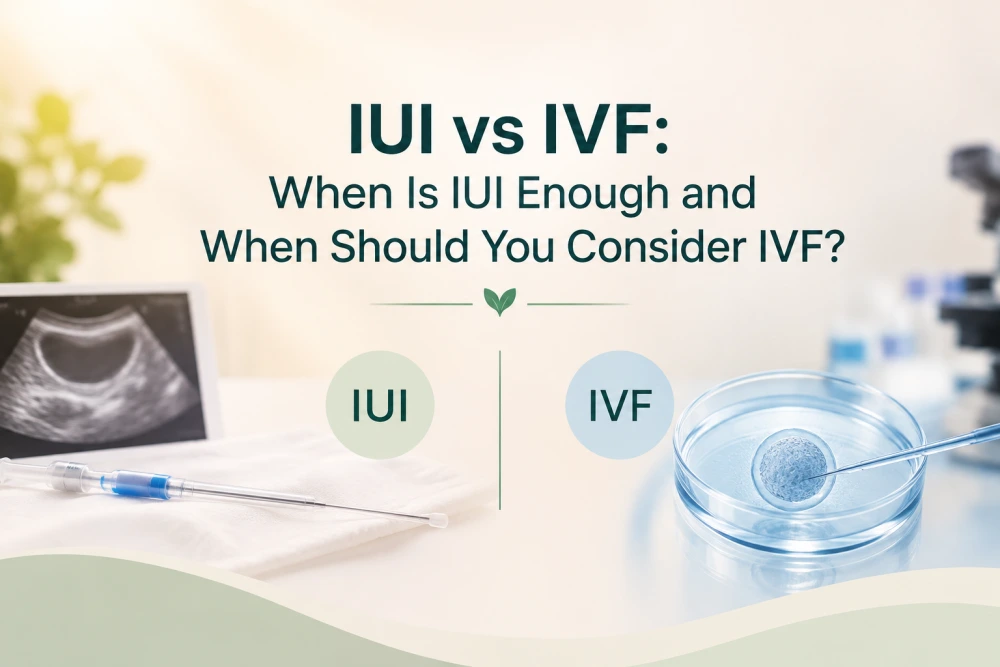
IUI (Intrauterine Insemination) is a simple procedure. Sperm is washed in aa lab and placed inside the uterus around the time of ovulation. Fertilisation then happens naturally inside the body. ICMR groups it as Level 1 ART.

What Is IVF?

In IVF (In Vitro Fertilisation), eggs are collected from the ovaries and joined with sperm in a lab. The embryo is then placed in the uterus. ICMR groups it as Level 2 ART.

Key Differences at a Glance

Here is the difference between IUI and IVF in plain terms:

  • Medicines: IUI needs mild stimulation tablets or injections, or none. IVF needs stronger injections.
  • Procedure: IUI is done in the clinic and takes a few minutes. IVF needs egg collection under sedation.
  • Cost and time: IUI costs less and takes one cycle. IVF needs more visits and a higher budget.

IUI vs IVF: Which Is Better?

Many people ask, “IUI vs IVF which is better?” Neither is better for everyone. In general, IVF has a higher success rate per cycle, but it is heavier on the body and budget. IUI is gentler and is usually considered when the cause is mild.

ICMR asks doctors to follow evidence-based, individual treatment and reminds them that the age of the woman is the most important factor. So in IUI vs IVF, the suitable option is the one that matches your tubes, ovulation, ovarian reserve, sperm report and age.

When Is IUI Enough?

Conditions Where IUI Works Well

As per the ICMR workflow, ovarian stimulation with IUI for 3 to 6 cycles is the usual first step when:

  • The fallopian tubes are open (confirmed by HSG or laparoscopy)
  • Ovulation is documented
  • Antral follicle count is 5 or more
  • AMH is 1.2 ng/ml or more

IUI in PCOS and Tubal Problems

For women who do not ovulate regularly, as in PCOS, ICMR suggests ovulation induction with or without IUI for 3 to 6 cycles. If a damaged, fluid-filled tube (hydrosalpinx) is removed or clipped and the other tube is open, IUI can still be tried.

When to Choose IVF Over IUI

When ICMR Points Towards IVF

In the IUI vs IVF decision, ICMR points towards IVF or ICSI in these situations:

  • Both fallopian tubes are blocked, or both have been removed or clipped
  • Poor ovarian reserve (antral follicle count below 5 or AMH below 1.2 ng/ml)
  • 3 to 6 IUI cycles have been completed without pregnancy
  • Uterine problems that surgery cannot correct
  • Age-related decline in fertility

Other Reasons Doctors May Suggest IVF Sooner

Endometriosis, very low sperm count and the need for embryo genetic testing as reasons doctors may suggest IVF earlier. You can read more in this research paper on PubMed.

IUI vs IVF Success Rate: What Affects It?

Factors That Affect Results

People often search for one number for the IUI vs IVF success rate, but no single figure applies to every couple. In general, IVF has a higher success rate per cycle, while IUI results depend on the cause of infertility and whether stimulation medicines are used. These factors matter most:

  • Age of the woman (the most important factor, as per ICMR)
  • Egg and sperm quality
  • Cause of infertility
  • Number of cycles already tried
  • Quality of the clinic and lab

Risks and Practical Points

  • IUI: mild cramps are common, and stimulation can raise the chance of twins.
  • IVF: needs daily injections and sedation for egg collection, with a small risk of ovarian overstimulation.
  • Both: cost and emotional stress are real, so plan ahead.

Tests That Decide IUI or IVF for Infertility Treatment

Essential Tests

The choice of IUI or IVF for infertility treatment should never be made without basic tests. ICMR lists these as essential:

  • Transvaginal ultrasound to check the uterus, ovaries and antral follicle count (day 2 to 5 of the cycle)
  • HSG to check whether the tubes are open
  • Semen analysis for the male partner

Extra Tests Doctors May Add

Depending on the case, doctors may also add AMH, thyroid (TSH), prolactin, FSH and LH, and viral markers. ICMR also expects the treatment plan, cost and consent to be discussed before treatment starts. Conditions like PCOS and endometriosis may need treatment first.

Conclusion: IUI vs IVF Depends on Your Reports

IUI vs IVF is not about choosing the stronger treatment. It is about choosing the one that fits your situation, as decided with your doctor:

  • Open tubes, normal ovulation and good ovarian reserve: ICMR suggests IUI for 3 to 6 cycles as the usual start.
  • Blocked tubes, poor ovarian reserve or failed IUI cycles: ICMR points towards IVF or ICSI.
  • Age above 35: ICMR advises earlier testing.

Frequently Asked Questions About IUI vs IVF

IUI vs IVF: which is better as the first treatment?

It depends on the reports. With open tubes, documented ovulation and fine ovarian reserve, ICMR suggests IUI first. ICMR points towards IVF when both tubes are blocked or ovarian reserve is poor.

How many IUI cycles should be tried before IVF?

The ICMR workflow mentions 3 to 6 cycles. If these fail, ICMR points towards IVF or ICSI next.

When should we start infertility tests?

After 12 months of trying if the woman is below 35, and after 6 months if she is above 35.

Can IUI work if one fallopian tube is damaged?

It can, if the other tube is open. ICMR advises removing or clipping a fluid-filled damaged tube first. If both tubes are blocked, ICMR points towards IVF.

Does age change the IUI vs IVF decision?

Yes. ICMR calls the age of the woman the most important prognostic factor, so decisions are often faster after 35.

(Visited 9 times, 3 visits today)

Leave A Comment

Your email address will not be published. Required fields are marked *